
GST Compliance, Handled – From Invoice to Return
The GST rules that matter for traders and shops in 2026, explained simply with official sources, and how VelBooks helps you follow them.
Last updated: 14 October 2026
GST changes in 2025–26 every business should know
| Change | What it means | Official source |
|---|---|---|
| GST 2.0 rate rationalisation | From 22 Sep 2025, most goods and services moved to two main slabs, 5% and 18%, plus a 40% rate for select goods. Some items moved to nil. Certain tobacco products stay at old rates plus cess until a notified date. | PIB: 56th GST Council |
| E-invoicing above ₹5 crore | Businesses with aggregate annual turnover above ₹5 crore (in any year from 2017-18) must report B2B, export and SEZ invoices to the Invoice Registration Portal (IRP) to get an IRN and QR code. | e-Invoice portal |
| 30-day e-invoice reporting limit | From 1 Apr 2025, taxpayers with AATO of ₹10 crore and above must report invoices to the IRP within 30 days of the invoice date. | GSTN advisory |
| E-way bill above ₹50,000 | Movement of goods worth more than ₹50,000 generally needs an e-way bill (Rule 138). Some states set different limits for intra-state movement. | CGST Rule 138 |
| E-way bill document age and extension | From 1 Jan 2025, an e-way bill can only be generated for documents up to 180 days old, and total validity with extensions is capped at 360 days. | EWB advisory |
| MFA for EWB and e-invoice portals | Multi-factor authentication is mandatory for logging in to the e-way bill and e-invoice portals from 1 Apr 2025. | EWB advisory |
| GSTR-3B liability locked | From the July 2025 tax period, auto-populated tax liability in GSTR-3B can't be edited. Corrections go through GSTR-1A. What is and isn't locked. | GSTN advisory, 7 Jun 2025 |
| GSTR-3B Table 3.2 locked | From the November 2025 tax period, inter-state supplies to unregistered persons, composition taxpayers and UIN holders in Table 3.2 are filled from GSTR-1/1A/IFF and can't be edited. | GSTN advisory, 5 Dec 2025 |
| Three-year time bar on returns | Returns can't be filed more than three years after their due date (Finance Act, 2023). The portal enforces this from the November 2025 tax period; for example, GSTR-1 and GSTR-3B for October 2022 were barred from 1 December 2025. | GSTN advisory, 29 Oct 2025 |
| Multistate registration | Announced 1 Oct 2026: a “Multistate Registration” option on the GST portal lets a normal taxpayer apply for registration in several States/UTs under one PAN using a Master TRN. | GSTN advisory, 1 Oct 2026 |
| 57th GST Council recommendations (8 Oct 2026) | Recommended, not yet in force as of 20 Oct 2026: late-fee waiver for taxpayers up to ₹5 crore turnover if a delayed return is filed by the end of the month it was due; maximum general penalty (Section 125) cut from ₹25,000 to ₹10,000; no show cause notice below ₹10,000 tax; e-way bill interception only on specific intelligence; e-invoicing extended to RCM purchases from unregistered persons and import of services for ₹5 crore+ turnover; a new mechanism to correct liability and ITC in returns from the April 2027 return; an optional annual-return, quarterly-payment (ARQP) scheme approved in principle for B2C-only businesses up to ₹5 crore. No GST rate slab changes. GSTN published educational FAQs on 13 Oct 2026; they do not have independent legal force. On 16 Oct 2026 GSTN added the RCMDOM and RCMIMP e-invoice supply types for RCM self-invoices to the IRP sandboxes only; production date to be announced (what it means). Each recommendation takes effect only once it is notified. | PIB: 57th GST Council, 8 Oct 2026; GSTN FAQ advisory 676; GSTN advisory 678 (RCM e-invoicing, 16 Oct 2026); FAQ PDF |
| GSTR-9 / 9C for FY 2025-26 enabled | GSTN enabled annual returns in Form GSTR-9 and GSTR-9C for FY 2025-26 on the GST portal from 8 October 2026. File all applicable GSTR-1 and GSTR-3B for that year before the GSTR-9/9C tile appears. Ordinary due date under Rule 80 is 31 December following the FY (confirm on the portal). | GSTN advisory 677, 13 Oct 2026 |
Summaries are for general information and may not cover every condition. Check the linked official source or your tax adviser before acting.
How VelBooks keeps you compliant
- GST invoices with GSTIN, HSN/SAC, place of supply and the correct CGST/SGST or IGST split
- Item-wise GST rates, so a rate change like GST 2.0 is updated once per item, not on every bill
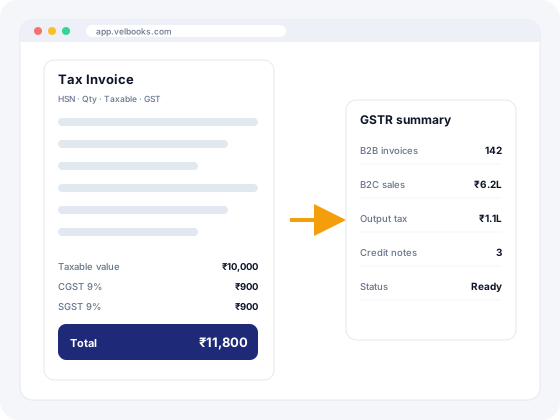
- GSTR filing and return management built on the invoices and purchases you record
- Financial accounts that match your GST data
- Sales and purchase records kept together for reconciliation and audits
Need e-invoicing (IRN) or e-way bills? Talk to us about your requirements.
Your GST compliance calendar
| When | Task |
|---|---|
| Every day | Create GST invoices for all sales; record purchase bills as goods arrive |
| By the 11th | File GSTR-1 for the previous month (monthly filers) |
| 1st–13th | Upload B2B invoices in IFF (optional, QRMP filers, months 1 and 2 of the quarter) |
| By the 13th after the quarter | File quarterly GSTR-1 (QRMP filers) |
| Around the 14th | Check GSTR-2B for input tax credit available |
| By the 20th | File GSTR-3B and pay tax (monthly filers) |
| By the 25th | Pay tax through PMT-06 for months 1 and 2 of the quarter (QRMP filers) |
| 22nd/24th after the quarter | File quarterly GSTR-3B (QRMP filers, depending on state) |
Due dates can be extended by notification. Always confirm on the GST portal.
Free tools and guides
GST Calculator
Add or remove GST at 0%, 5%, 18% or 40% and see the CGST/SGST or IGST split.
Learn more →GST Invoice Generator
Fill a form, get a GST invoice, then print or save it as PDF. Free, no signup.
Learn more →HSN / SAC Code Finder
Search the official GST HSN and SAC list by product name or code, or browse by chapter.
Learn more →E-Way Bill Checker
Check whether an e-way bill is needed and calculate its validity from the distance.
Learn more →E-Invoice Checker
Check whether e-invoicing applies to you and the 30-day deadline to report an invoice.
Learn more →GST Late Fee Calculator
Late fee and 18% interest for GSTR-3B, GSTR-1, GSTR-4 and GSTR-9, with current caps.
Learn more →Barcode Generator
Make Code 128 or EAN-13 barcodes and print labels on A4 sheets or label rolls.
Learn more →GST 2.0 New Rates (from 22 Sep 2025): What Retailers Must Update
GST & compliance
Learn more →E-Way Bill Rules 2026: Limits, Validity and the 180/360-Day Rules
GST & compliance
Learn more →GSTR-1 vs GSTR-3B: Differences, Due Dates and the 2025 Changes
GST & compliance
Learn more →How to File GSTR-1 on the GST Portal: Step-by-Step Guide (2026)
GST & compliance
Learn more →What Is an HSN Code? Meaning, Digits and How to Find Yours
GST & compliance
Learn more →E-Invoice Turnover Limit 2026-27: Who Must Generate an IRN, and the Time Limits
GST & compliance
Learn more →GST Invoice Rules: Time Limits, Free Samples, Contents and Document Types
GST & compliance
Learn more →How to Generate an E-Way Bill: Step by Step on the Portal, by SMS or App
GST & compliance
Learn more →GSTR-3B Lock: What's Locked, What Isn't, and the Three-Year Time Bar
GST & compliance
Learn more →Can I File a GST Return Without a CA?
GST & compliance
Learn more →Frequently asked questions
What are the current GST slabs?
Is e-invoicing mandatory for my business?
When is an e-way bill required?
What did the 57th GST Council meeting decide?
When can I file GSTR-9 for FY 2025-26?
How does VelBooks help with GST compliance?
Run billing, stock and your online store from one app
Sign up at app.velbooks.com and use the full app free for 30 days. Questions first? Call or WhatsApp us.
Or call +91 81472 70720 · admin@finacc.in