
GST Return Filing & Management From Your Own Books
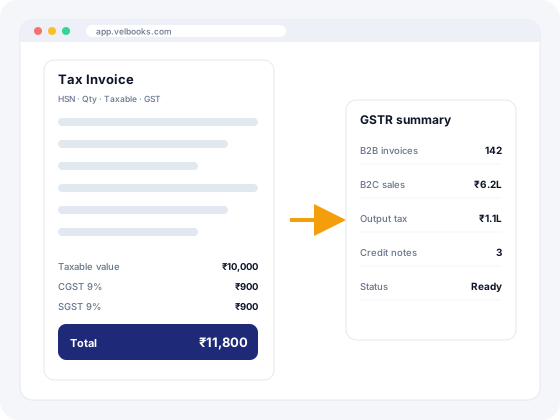
Your GST returns start with your invoices. VelBooks keeps sales and purchase data organised for GSTR filing and return management.
Return data that comes straight from your books
The hardest part of GST filing is not the portal; it's collecting accurate data. When sales live in a bill book and purchases in a file, someone has to re-type everything at month end, and mismatches follow. In VelBooks, every invoice and purchase you record is already organised for your returns.
- Sales data from your VelBooks GST invoices, with GSTIN, HSN and tax split
- Purchase entries recorded with supplier GSTIN for your input tax credit review
- GSTR filing and return management in the same app
- Fewer mismatches between your books, GSTR-1 and GSTR-3B
GST returns and due dates at a glance
| Return | Who files | What it contains | Due date |
|---|---|---|---|
| GSTR-1 | Regular taxpayers (monthly) | Invoice-wise details of outward supplies (sales) | 11th of the next month |
| GSTR-1 (QRMP) | Turnover up to ₹5 crore opting for QRMP | Quarterly sales; B2B invoices can be uploaded monthly through IFF | 13th of the month after the quarter (IFF: 1st–13th) |
| GSTR-3B | Regular taxpayers (monthly) | Summary of sales, ITC claimed and tax paid | 20th of the next month |
| GSTR-3B (QRMP) | QRMP taxpayers | Quarterly summary; tax paid monthly via PMT-06 by the 25th | 22nd or 24th of the month after the quarter, depending on state |
| CMP-08 / GSTR-4 | Composition taxpayers | Quarterly tax statement / annual return | 18th after each quarter / 30 June (from FY 2024-25) |
| GSTR-9 | Regular taxpayers (optional up to ₹2 crore turnover) | Annual return | 31 December after the financial year |
Changes since 2025 that make accurate GSTR-1 essential
- GSTR-3B liability is locked: from the July 2025 tax period, the tax liability auto-populated into GSTR-3B from your GSTR-1/IFF can't be edited in GSTR-3B. Corrections go through GSTR-1A before you file GSTR-3B.
- Table 3.2 locked too: from the November 2025 tax period, inter-state supplies to unregistered persons, composition taxpayers and UIN holders in Table 3.2 are also non-editable.
- Three-year time bar: returns can't be filed more than three years after their due date. The GST portal enforces this from the November 2025 tax period.
- GST 2.0 rates: from 22 September 2025, most goods moved to the 5% and 18% slabs with 40% for select goods, so item rates had to be updated.
For a detailed explanation, read GSTR-1 vs GSTR-3B: differences, due dates and the 2025 changes and what is (and isn't) locked in GSTR-3B.
Sources: GSTN advisory on the GSTR-3B liability lock, GSTN advisory on Table 3.2, GSTN advisory on the three-year bar, CGST Rule 62 (GSTR-4 due date, amended by Notification 12/2024-CT), CBIC. Due dates can be extended by notification; always check the portal.
A simple monthly GST routine
- Record every sale as a GST invoice in VelBooks and every purchase bill when goods arrive.
- Before the 10th, review the month's sales: customer GSTINs, HSN codes and any credit notes.
- Compare your purchase records with GSTR-2B on the GST portal to confirm which input tax credit you can claim.
- File GSTR-1 (or upload IFF), then check the auto-populated GSTR-3B. Correct errors through GSTR-1A if needed.
- Pay tax and file GSTR-3B by the due date.
Frequently asked questions
Can I file GST returns without a CA?
What is the difference between GSTR-1 and GSTR-3B?
Does VelBooks help with GST returns?
What happens if I file late?
Run billing, stock and your online store from one app
Sign up at app.velbooks.com and use the full app free for 30 days. Questions first? Call or WhatsApp us.
Or call +91 81472 70720 · admin@finacc.in